Press
Gift Sets, GWP & Holiday Bundles: How to Plan Kitting for BFCM
Nov 06, 2026
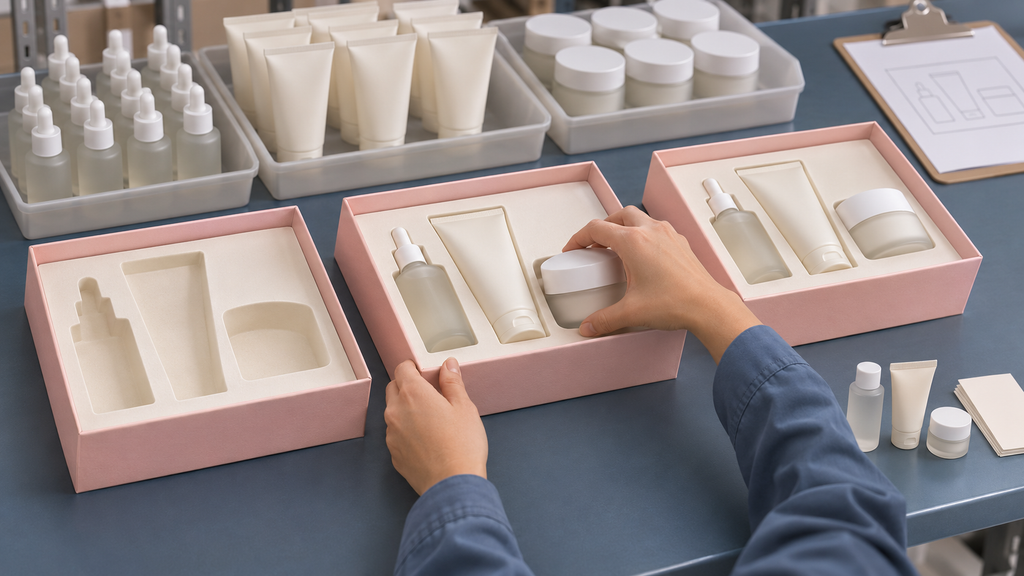
The packing team has a cleanser, a serum, two sizes of moisturizer, and a stack of holiday boxes. The order says “Complete Routine.” Which moisturizer belongs in the set? Does the sample go inside the presentation box or alongside it? Is the instruction card the current version?
Those decisions belong in the kit instructions before the first order arrives. For beauty and wellness brands, effective kitting services turn an approved product combination into a repeatable build: the right components, the right quantities, the right presentation, and a clear instruction for each order.
Preparing holiday gift sets for Black Friday and Cyber Monday (BFCM) starts with a practical sequence: define the finished set, choose when to assemble it, allocate its components, test the order information, and approve a packed sample. Each step should leave the fulfillment team with something it can use.
Quick preparation checklist
- Create one approved build sheet for every set and variation.
- Choose an assembly method and a realistic starting quantity.
- Allocate products, gifts, and packaging without counting the same stock twice.
- Run test orders through the actual fulfillment workflow.
- Approve the packed sample and confirm who can authorize changes.
1. Define the build before scheduling kitting services
A product photograph shows the intended look. A build sheet explains how to reproduce it. Start with the name or SKU used to order the finished set, followed by the exact component SKUs and quantities needed to make one.
For a skincare routine, distinguish the 30 mL serum from the 10 mL mini and identify the moisturizer by size and formula. For a wellness starter set, specify the product variant and accessory. Similar-looking items should never require a packer to guess which version was promised.
Add the packaging recipe: presentation box, internal supports, tissue, sleeve, instruction card, and outer shipping carton. Show the approved arrangement and identify the current version of each printed item. A card from an earlier launch can look almost identical while giving the wrong product instructions.
Keep a sample or reference photographs with the instructions. Where different variations share components, give each variation its own clear description. MasonHub’s kitting and assembly options can then be discussed against a defined build rather than a general request to “make it gift-ready.”
2. Choose between pre-kitting, dynamic kitting, and kit-at-pack
Choose the method around the work involved and when the products need to become a finished set. A fixed presentation with several assembly steps may suit an advance build. A simple combination with variable contents may be better assembled against incoming orders.
| Approach | How it works | What to agree before release |
| Pre-kitting | A batch is assembled before orders arrive. | Build quantity, component allocation, completion date, and finished-set storage. |
| Dynamic kitting | Components are brought together for a specific incoming order. | The kit recipe, component availability, and how the order identifies the combination. |
| Kit-at-pack | Assembly is completed at the packing station. | What arrives at the station, the handling sequence, and the finished presentation. |
| Combined approach | An advance batch covers core demand; other combinations are built to order. | Which quantities are already assembled and which components remain available. |
| Assembly | The program includes agreed hands-on preparation. | The specific handling steps, approved sample, and work required per set. |
Pre-kitting moves assembly work ahead of order release. It also commits components to a particular presentation, so agree the first build quantity and the point at which another batch should be considered. Avoid treating the entire sales forecast as an instruction to assemble everything immediately.
Dynamic kitting keeps products as components until an order calls for the combination. That can reduce reliance on pre-assembled stock, but the work still needs time and capacity. Products and seasonal packaging can remain unsold; flexibility does not remove that risk.
Kit-at-pack identifies where assembly happens. It can overlap with an order-driven method. Describe the actual sequence with your fulfillment team so “build on demand” and “finish at packing” lead to the same instructions.
3. Calculate the quantity you can actually build
For bundle fulfillment, calculate availability from the complete recipe. If one set needs two units of a product, its usable stock supports half as many sets. Packaging can be the limiting component just as easily as the bestselling serum.
Consider a hypothetical wellness set containing two product pouches, one reusable accessory, and one presentation box. The allocated stock is 900 pouches, 500 accessories, and 400 boxes. The pouches support 450 sets, the accessories 500, and the boxes 400. The starting build limit is therefore 400 sets.
If 100 of those pouches are subsequently reserved for individual orders, the remaining 800 still support 400 sets. Reserve another 100 and the limit falls to 350. That change should reach the team controlling build quantities before more work is released.
Use received, checked, and usable stock for the calculation. Keep unreceived deliveries and items awaiting inspection separate. Allocate components shared across individual sales, other kits, and promotional gifts, including any agreed allowance for damage or replacement.
For holiday gift sets, also check the applicable lot, expiry, and remaining-shelf-life requirements before assembly. MasonHub’s inventory management services support kit-count visibility and lot and expiry management. Agree how the requirements apply to the components in your particular set.
4. Make the order tell the warehouse what to build
The warehouse needs an unambiguous instruction for the combination purchased. A set may arrive in an order as one kit SKU or as separate component lines. Confirm how your setup handles that structure and how the picker will know what belongs together.
In a test order for a cleanser-and-serum duo, check that the fulfillment record calls for one cleanser and one serum. If the order also contains an individual serum, the expected total is two serums. This simple test can reveal an incorrect mapping before it affects live orders.
MasonHub’s fulfillment platform provides SKU-level order visibility and supports configured bundling and packaging rules. Review the actual order with the team, including its packing instructions. The storefront displaying the right bundle is only the first part of the check.
5. Test gift with purchase fulfillment as a separate instruction
A purchased set and a promotional gift have different jobs in the order. The kit recipe determines the paid contents; the gift instruction determines whether an extra item is added. Keeping those instructions clear helps prevent a sample being omitted or counted as part of the purchased set.
MasonHub’s Fulfillment Automated Marketing Engine (FAME) uses order attributes to support configured samples, gifts with purchase, inserts, and custom packaging. For gift with purchase fulfillment, agree which information reaches FAME and how the configured instruction should appear during packing.
Use a small set of test orders with a written expected result:
- Qualifying order: the correct gift and insert appear once, in the agreed location.
- Non-qualifying order: no promotional gift is added.
- Kit plus individual products: purchased quantities remain correct alongside any eligible gift.
- Unavailable gift: the team follows the approved exception process rather than choosing a substitute.
- Changed order: the team checks whether gift eligibility and packing instructions need to change.
A mini moisturizer used both inside a paid set and as a free gift needs two distinct instructions, even if it comes from the same component stock. Record where it belongs in each case. Any fallback, replacement, or special exception should be confirmed for the program rather than assumed to be automatic.
6. Approve one complete pack before releasing the build
Inspect the finished set as the recipient will receive it, including the outer shipping package. Check component count, product versions, placement, protective materials, inserts, and presentation. The approved sample should match the current build sheet.
With beauty products, look for bottle movement, pressure on closures, and rubbing between printed surfaces. With wellness products and accessories, check that heavier items cannot move onto lighter containers. A set that looks good open on a desk still needs suitable protection when closed and shipped.
When scoping kitting services, include the time needed for detailed placement, folding, wrapping, and checking. For bundle fulfillment, document the completed parcel’s weight and dimensions too. Those details help your team assess the actual work and shipping requirements.
Use the first completed units to check that the instructions are reproducible. If the sample needs adjusting, update the build sheet before releasing the rest of the batch. Name the person who approves the change so several conflicting versions do not reach the packing team.
7. Set release dates and a process for changes
Work backward from the required ship-ready date. Confirm when specifications must be approved, when every component must be received and available, when assembly can take place, and when test orders must pass. Ask your MasonHub account team for the configuration and inbound deadlines applicable to the BFCM program.
Assign an owner to each handoff. The brand approves contents and presentation; the ecommerce team checks order information; the fulfillment team confirms the agreed build and packing workflow. Resolve missing components or failed tests before authorizing the affected work.
During production, record completed sets, component usage, and discrepancies. If a product, sleeve, or card changes, identify which instruction version applies to unfinished work and orders already in progress. Contact the MasonHub team before changing an existing kit configuration.
At the end of the program, reconcile finished sets and remaining components. Agree any rework before opening the assembled stock or changing its presentation. That gives the next build a reliable starting count and keeps leftover seasonal materials visible.
Build your BFCM kitting plan with MasonHub
Bring MasonHub a clear build sheet, component quantities, expected order volume, packaging sample, and target release date. Its kitting services, beauty fulfillment, and wellness fulfillment support the practical work behind a finished set. Request a MasonHub quote to discuss the assembly approach, order setup, packing requirements, and milestones for your program.
Frequently asked questions
When should a brand choose pre-kitting over dynamic kitting?
An advance build can suit a fixed combination with approved packaging and predictable demand. Building against orders can suit variable combinations or products also sold individually. Compare the assembly work, available capacity, storage, and quantity you are prepared to commit.
Does kit-at-pack mean the gift rule is already configured?
No. It describes the assembly stage. A promotional gift still needs an agreed eligibility instruction, available stock, and a tested packing workflow. Discuss the gift rule and the physical packing process together.
What belongs in a build sheet for holiday gift sets?
Include the finished-set identifier, component SKUs and quantities, product variants, packaging, printed-material versions, and assembly sequence. Add reference photographs and an approval owner. Record any permitted alternative explicitly so the packer does not have to decide.
How do we check gift with purchase fulfillment before launch?
Place test orders with known expected contents. Cover qualifying and excluded orders, kit-plus-individual purchases, unavailable gifts, and order changes. Compare the order record, packing instructions, and finished parcel, then resolve differences before approving the workflow.
What should a brand confirm before starting bundle fulfillment?
Confirm the recipe, usable component allocation, assembly method, order mapping, approved sample, and program-specific dates. A component delivery alone does not make a build ready: the goods must be checked and available, and the instructions and tests must be approved.